
Raw Reflections
I woke up in a funk today—one of those heavy-blanket moods that makes isolation feel safer than showing up. Work tasks piled up, paralysis set in, and the inner critic started chanting its tired song about productivity and worth.
I woke up in a funk today—one of those heavy-blanket moods that makes isolation feel safer than showing up. Work tasks piled up, paralysis set in, and the inner critic started chanting its tired song about productivity and worth.
The overwhelm wasn't just about tasks. It was deeper—relationships, desires, the weight of things I couldn't quite name. I found myself procrastinating, unable to move forward, caught in that familiar spiral where the more I resist doing something, the heavier it becomes.
On the ride home on my motorbike, I plugged into Ram Dass's old "God, Sex & Dope" talk. At the end, he breaks into song—that old round from childhood:
"Rejoice in the Lord always, and again I say, rejoice."
I'd sung that as a kid in church camps, but hearing Ram Dass chant it—playfully, timelessly—was a jolt. It reminded me that joy isn't earned by finishing a to-do list; it's a homecoming to something already present.
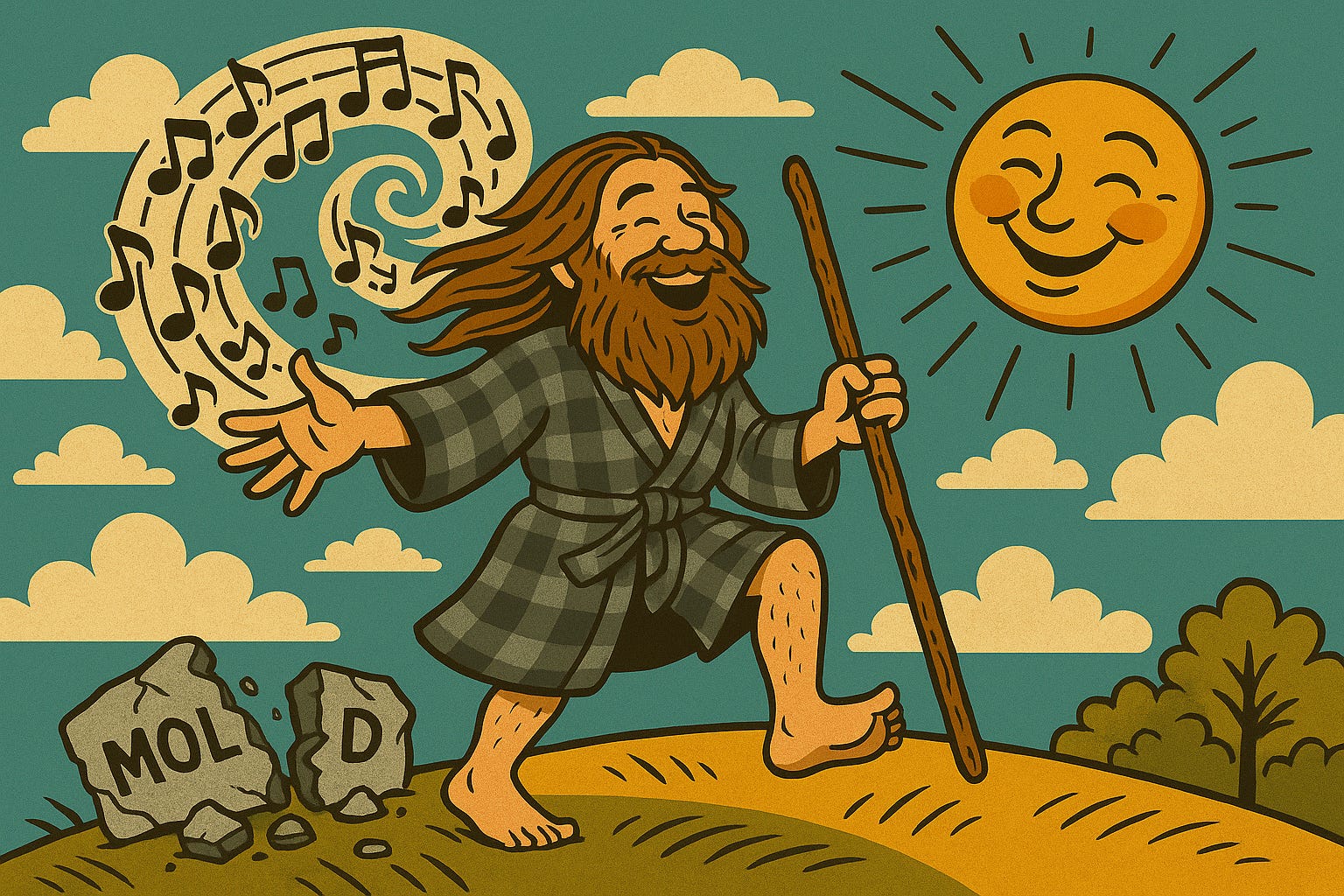
After arriving home, I intentionally walked into my woods with my bluetooth speaker, needing the trees and the silence to reset my spirit. That's when Twiddle's "Every Soul" came on shuffle. The line that stopped me cold: *"'Cause all we're taught is to fit the mold."*
Standing there among the trees, that lyric exposed the clamp I'd been feeling—not just on my productivity, but on my spirit. The music, Ram Dass's chant, the quiet of the woods—all pointing me back to what I later told my AI collaborator: "There's so much in every soul, and you find that depth of your soul when you touch the divine."
That Twiddle line—"'Cause all we're taught is to fit the mold"—vibrates like quiet rebellion wrapped in a gentle melody. In today's political landscape, where "traditional values" are wielded to regulate expression, those words feel especially pointed. Conservative rhetoric often frames divergence as danger, demanding conformity under the guise of protection.
But the mold isn't conservation—it's containment. The spiritual traditions that conservatives claim to guard were birthed by radicals: prophets, mystics, prisoners whose joy threatened the status quo. Remembering that lineage reframes rebellion as fidelity to the deeper law of becoming.
My stalled workday wasn't laziness; it was signal. Overwhelm often masks a subtler need: to pause long enough to feel what's really happening beneath the surface. The psyche can't integrate when it's sprinting. In that stillness—first with Ram Dass in the car, then with Twiddle in the woods—permission surfaced to step out of the productivity trance.
The Apostle Paul wrote "Rejoice in the Lord always" from a prison cell to a struggling community in Philippi, insisting that joy is possible even behind bars. Nearly two millennia later, Ram Dass closes a 1970s talk by looping the same verse, turning a Sunday-school round into a mantra of return—no doctrine required, just a doorway back to presence.
The round structure matters: voices enter at staggered times, weaving harmony out of delay. It's an auditory reminder that inner and outer can sing together even when they're not in sync.
Both the funk-jam groove of Twiddle and the camp-song simplicity of "Rejoice" function like spiritual APIs—low-bandwidth protocols that carry high-resolution truth. They bypass cognitive overload, drop the nervous system into rhythm, and give the soul a place to speak. A three-minute track can crack open a day in ways that productivity hacks never could.
Ram Dass often said the darker the night, the brighter the stars. The low spell wasn't an obstacle to joy; it was compost. By noticing the heaviness, then layering song on top of silence in the woods, my psyche completed a circuit: awareness → feeling → resonance → release. Joy didn't obliterate the funk; it alchemized it.
Tonight's takeaway is embarrassingly simple: I don't have to earn my way back to center; I can sing my way there.
Next time the mold tightens or the task-list glare blinds me, I'll pause, breathe, and remember the round: *Rejoice in the Lord always...* Maybe I'll even let Twiddle's bassline shake the dust off my shoulders.
Because every soul—including mine on an overwhelmed Tuesday—contains its own sanctuary, waiting for the door of sound to swing open.
---
This piece emerged from a voice conversation with my AI collaborator, exploring how music and memory intersect with spiritual practice. The collaboration helped me see patterns I might have missed, while staying true to the raw experience that sparked the reflection.
For more explorations of consciousness, technology, and collaborative storytelling, check out my sci-fi solar-punk AI collaborative novel at stillpointproject.org.